

Common Grinder Cleaning Mistakes That Could Be Costing You More Than You Think
September 29, 2026Common Grinder Cleaning Mistakes That Could Be Costing You More Than You Think
September 29, 2026The Ultimate Guide to Commercial Coffee Grinder Burr Replacement
Understanding Burr Wear and Knowing When It's Time to Replace Them
"The performance of every commercial coffee grinder depends on one component that many businesses rarely think about – until coffee quality starts to decline."
Why this guide matters
If you've ever found yourself asking why your espresso suddenly tastes different, why your grinder takes longer to produce a dose, or why your baristas seem to be constantly adjusting the grind throughout the day, you're not alone – add in ‘Or you can’t get your grinder to go fine enough’
For many commercial coffee businesses, these changes happen so gradually that they become part of the daily routine. Recipes are adjusted, extraction times are tweaked and staff simply compensate without realising that the grinder itself may be the problem.
More often than not, the culprit is something surprisingly simple.
Worn grinder burrs.
Every commercial grinder relies on sharp, precision-engineered burrs to produce a consistent particle size. As those burrs gradually wear through everyday use, grinding performance begins to change. Coffee quality becomes less predictable, workflow slows ‘due to constant grinder adjustments’ and equipment has to work harder to achieve the same result.
The good news is that worn burrs don't have to become an expensive problem.
Recognising the early warning signs and replacing them at the right time can help maintain coffee quality, improve workflow and extend the life of your grinder.
Whether you operate an independent café, hotel, restaurant, coffee roastery, university café, contract catering business or manage multiple hospitality sites, this guide explains everything you need to know.
Engineer's Insight
Burr wear is one of the most common causes of declining grinder performance, yet it's rarely noticed immediately. Because the change happens gradually, businesses often adapt without realising anything is wrong until coffee quality or service speed has already been affected.
Why Grinder Burrs Matter More Than Most Businesses Realise
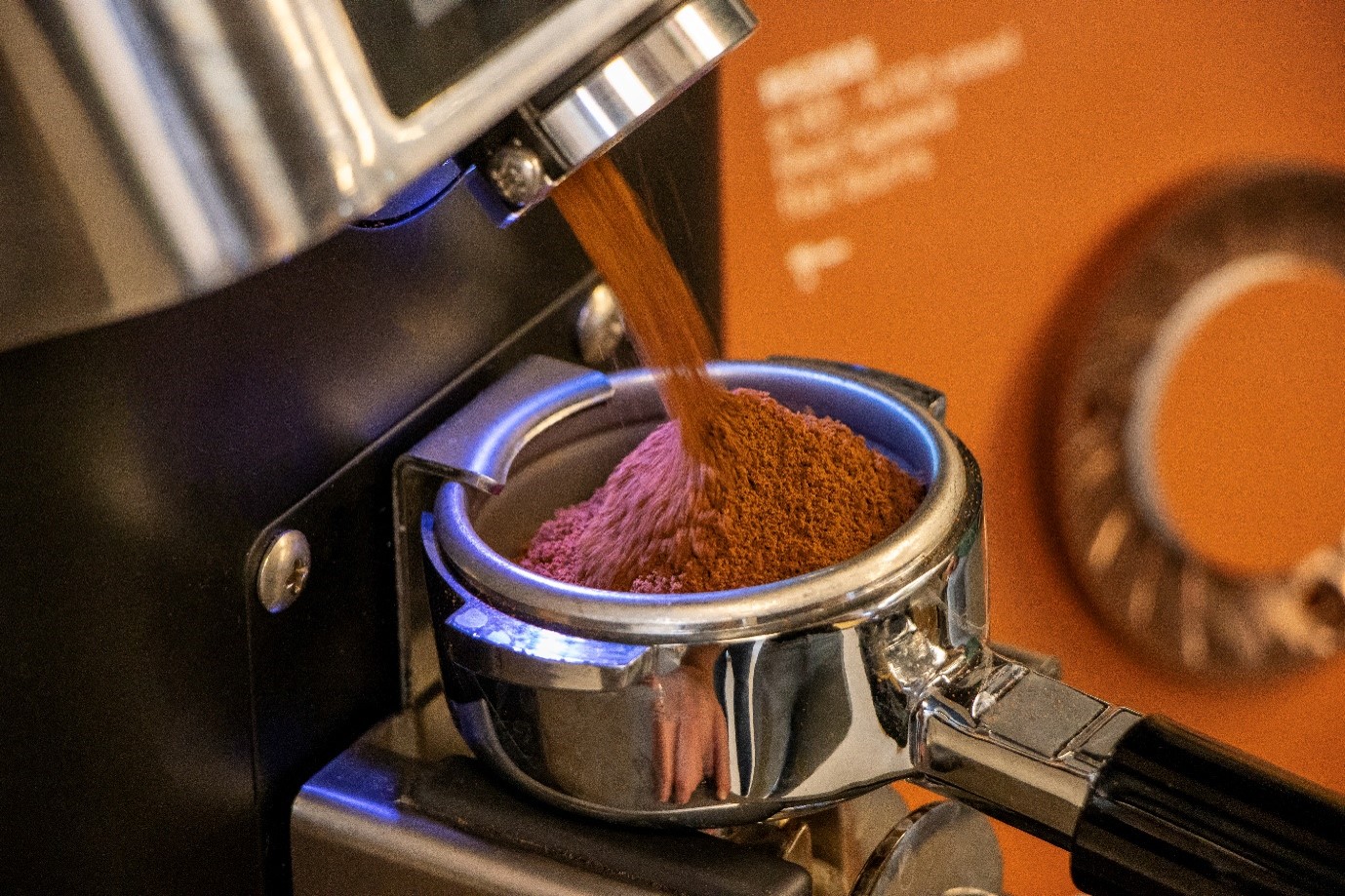
Ask someone what makes great espresso and they'll usually mention the coffee beans, the espresso machine or the skill of the barista.
Few people immediately think about the grinder.
Yet the grinder has arguably the greatest influence on extraction.
Before water ever reaches the coffee, the grinder determines the size, shape and consistency of every coffee particle.
If those particles aren't uniform, water cannot flow evenly through the coffee bed.
Some particles over-extract.
Others under-extract.
The result is espresso that lacks balance, clarity and consistency.
That's why professional coffee businesses invest in premium grinders from manufacturers such as Mahlkönig, Ceado, Anfim, HeyCafé and Ditting. Every one of these manufacturers understands that producing an accurate, repeatable grind is fundamental to making consistently great coffee.
However, regardless of the grinder you own, every burr set is a consumable component.
Eventually, they wear.
What Exactly Are Grinder Burrs?
Inside every commercial coffee grinder are two precision-machined burrs.
As coffee beans pass between them, the burrs progressively reduce each bean into particles suitable for brewing.
Unlike domestic blade grinders, which chop coffee unpredictably, burr grinders are engineered to produce a much narrower particle distribution.
This consistency allows espresso recipes to remain predictable throughout the day.
Different grinders use different burr geometries, diameters and materials, but they all perform the same essential job.
To produce repeatable, accurate coffee.
How Burrs Actually Wear
One of the biggest misconceptions is that burrs suddenly become blunt.
In reality, wear happens incredibly slowly.
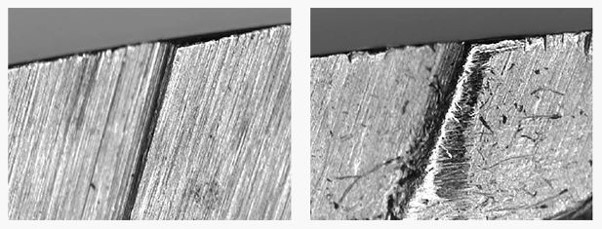
Every coffee bean passing through the grinder removes a microscopic amount of material from the burr's cutting edge.
Over thousands of grinding cycles these microscopic changes begin adding up.
Sharp cutting edges become rounded.
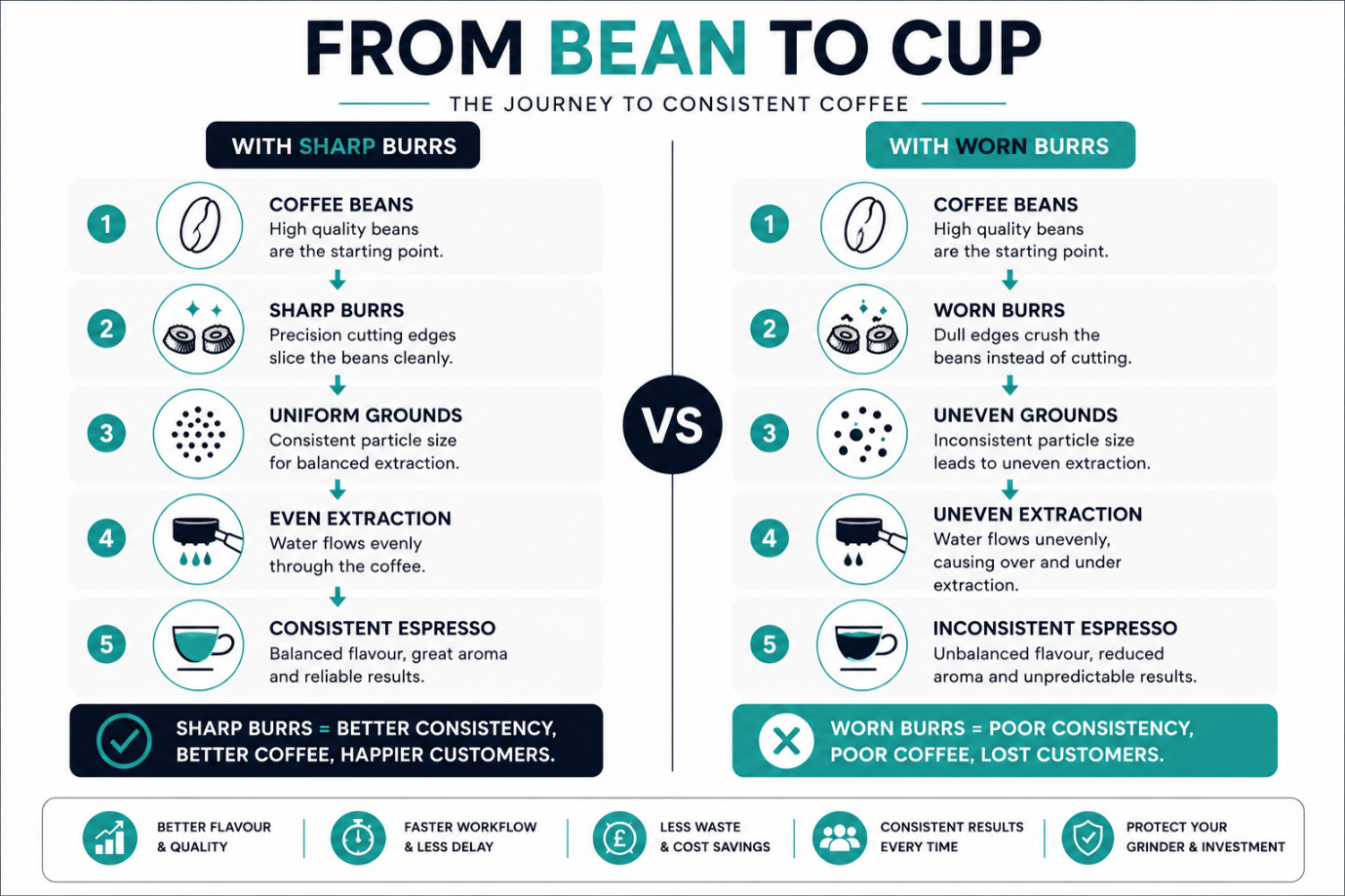
Rather than slicing cleanly through each bean, the burrs begin crushing the coffee.
This changes the particle distribution.
Instead of producing coffee grounds that are similar in size, worn burrs generate a wider mixture of:
- Fine powder-like particles
- Medium-sized particles
- Larger fragments
This uneven grind makes extraction increasingly unpredictable.
Engineer's Insight
Think of a chef's knife.
A sharp knife cuts cleanly and efficiently.
A blunt knife still cuts, but it requires more force, creates less accurate cuts and becomes harder to control.
Coffee grinder burrs behave in exactly the same way.
Why Worn Burrs Affect More Than Just Coffee Quality
Most businesses might first notice some changes to flavour.
However, worn burrs affect much more than the cup.
They can influence almost every stage of your workflow.
As grinding performance declines, you may notice:
- Longer grinding times
- More coffee waste
- Increased recipe adjustments
- Slower service during busy periods
- Less confidence from baristas
- Reduced consistency between staff members
These small issues often develop so gradually that operators simply adapt to them.
Over time, though, they begin affecting productivity and customer experience.
There Isn't a Fixed Replacement Interval
One of the most common questions operators ask is:
"How long should my grinder burrs last?"
Unfortunately, there isn't a universal answer.
Two identical grinders operating in different environments may require burr replacement at completely different times.
The lifespan of a burr set depends on factors including:
- Daily coffee volume
- Roast profile
- Grind setting
- Cleaning routine
- Coffee type
- Burr material
- Preventative maintenance
- Operator habits
For example, a busy city-centre café serving 350 coffees every day will naturally wear burrs much more quickly than a hotel producing breakfast service or a quieter restaurant serving coffee after meals.
This is why experienced engineers focus on performance rather than age.
Each burr set has a recommended life span in ‘Kgs’. This is a guide only. However you can roughly work out the life span by dividing the burr life recommendation in kilos by the grams per dose for your cafe.
New vs Worn Burrs
| New Burrs | Worn Burrs |
|---|---|
| Sharp cutting edges | Rounded cutting edges |
| Fast grinding | Slower grinding |
| Uniform particle size | Inconsistent particle sizes |
| Easier to dial in | Constant grind adjustments |
| Better flavour clarity | Flat or muddier coffee |
| Less coffee waste | Increased coffee waste |
| Smooth workflow | Slower service |
Eight Warning Signs Your Commercial Grinder Burrs May Need Replacing
Burr wear develops gradually.
Recognising the signs early allows you to restore grinder performance before coffee quality and workflow begin suffering.
- Coffee Doesn't Taste Quite Right
If espresso begins tasting flatter, muddier or less balanced despite using fresh coffee and the same recipe, burr wear should always be considered.
- You're Constantly Adjusting the Grinder
This is often known as grind creep.
If you find yourself moving progressively finer over several weeks just to maintain the same extraction time, your burrs may no longer be cutting efficiently.
- Grinding Takes Longer
Commercial grinders should produce doses quickly and consistently.
If grinding is becoming noticeably slower, worn burrs may be increasing resistance within the grinding chamber.
- You're Seeing More Fines
Healthy burrs produce a relatively uniform grind.
As they wear, you'll often notice:
- More dust-like coffee particles
- Larger fragments
- Increased clumping
- Less even extraction
- Dialling In Has Become More Difficult
Recipes that once remained stable throughout the day now require continual adjustment.
This is often one of the earliest operational signs of declining burr performance.
- Your Grinder Feels Hotter Than Normal
Additional friction can increase heat during grinding.
If the grinder body feels unusually warm or you're noticing burnt coffee aromas, it's worth arranging a professional inspection.
- Your Grinder Sounds Different
Grinding noise often changes before operators notice flavour changes.
Increased vibration, rattling or metallic sounds should never be ignored.
- The Burrs Show Visible Wear
Ultimately, visual inspection remains the most reliable way of confirming burr condition.
Regular servicing allows burr wear to be identified before it begins affecting coffee quality or placing additional strain on the grinder.
Protecting Your Investment and Keeping Your Grinder Performing at Its Best
By now, you'll understand that worn burrs don't simply affect the flavour of your coffee. They can influence every stage of your workflow, from dialling in each morning to serving customers during your busiest trading periods.
The next step is knowing how to respond before minor issues become major problems.
The Hidden Cost of Ignoring Burr Wear
It's easy to postpone replacing grinder burrs.
After all, the grinder is still producing coffee, customers are still being served and the business continues operating.
However, worn burrs rarely affect just one part of your coffee operation.
Their impact often spreads throughout the entire workflow.
Coffee Quality Begins to Drift
As particle size becomes less consistent, extraction becomes less predictable.
This often results in:
- Less balanced espresso
- Reduced flavour clarity
- Greater variation between shots
- More rejected coffees
- Increased customer complaints
Although these changes may seem minor individually, together they can gradually affect the reputation of your coffee offering.
Baristas Spend More Time Chasing Recipes
Instead of preparing drinks, staff spend valuable time:
- Adjusting grind settings
- Checking shot times
- Re-dialling recipes
- Purging coffee
- Wasting doses
During quieter periods this may simply be frustrating.
During a busy morning rush, it can significantly affect service.
Coffee Waste Increases
As recipes become harder to maintain, coffee waste naturally increases.
Extra purges.
Rejected shots.
More dialling in.
Over weeks and months this can represent a surprisingly significant cost.
Productivity Falls
Every additional second spent grinding, adjusting or remaking drinks reduces overall efficiency.
For busy commercial environments, slower workflow can quickly lead to:
- Longer queues
- Reduced customer satisfaction
- Increased staff pressure
- Lower productivity
Replacing burrs at the right time is often one of the smallest maintenance costs with one of the biggest operational benefits.
Engineer's Insight
One of the most common misconceptions is that burrs only affect flavour. In reality, worn burrs often influence workflow long before operators notice changes in the cup.
What Happens During a Professional Burr Replacement?
Many people assume replacing grinder burrs simply involves removing one set and fitting another.
Professional servicing involves considerably more than that.
A proper burr replacement is an opportunity to restore the grinder to peak performance while identifying any developing issues before they become expensive repairs.
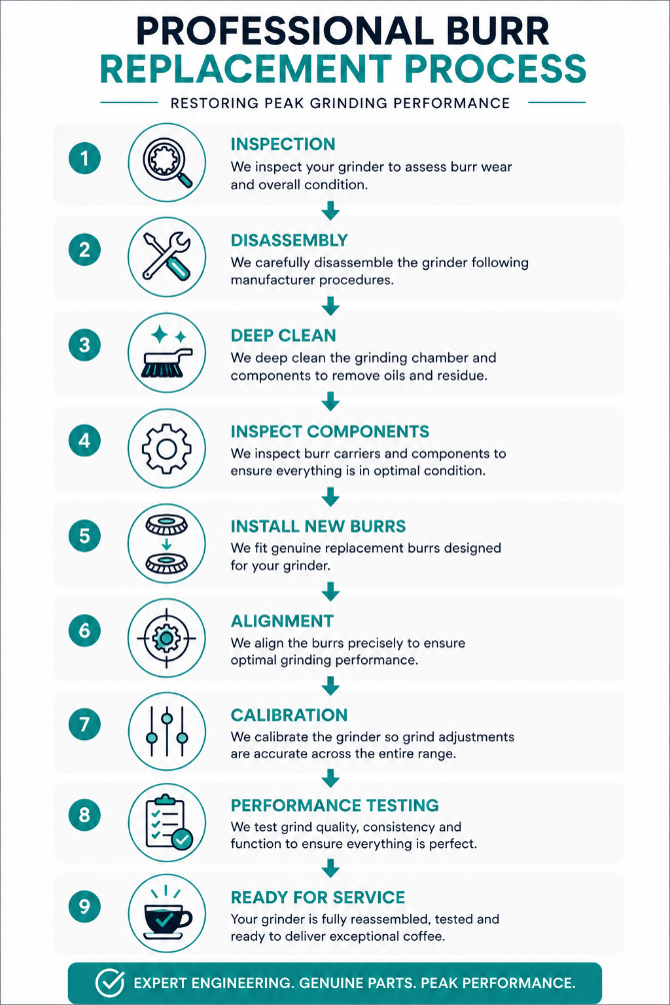
A typical service includes:
- Initial Inspection
The grinder is inspected for signs of wear, damage and general condition before any work begins.
- Safe Disassembly
The burr chamber is carefully dismantled following manufacturer procedures.
- Deep Cleaning
Old coffee oils, compacted grounds and residue are removed from the grinding chamber.
This not only improves hygiene but also restores grinding efficiency.
- Burr Carrier Inspection
The burr carriers and mounting surfaces are checked to ensure the new burrs will sit correctly.
Even slight contamination or wear can affect grind consistency.
- Installation of Genuine Replacement Burrs
New burrs are fitted using the correct procedures and torque settings where required.
- Burr Alignment
Correct alignment is essential.
Even premium burrs cannot perform correctly if they are misaligned.
- Calibration
The grinder is recalibrated to ensure grind adjustment corresponds accurately throughout its range.
- Functional Testing
Grinding performance is checked before the grinder returns to service.
- Final Dial-In
Where appropriate, the grinder is dialled in to produce the desired espresso recipe, helping operators return to service quickly.
Replace the Burrs or Replace the Grinder?
One of the questions commercial operators ask most often is whether replacing burrs is enough or whether it's time to invest in a new grinder.
In many cases, replacing the burrs is all that's required.
If the grinder has been well maintained and the motor, bearings and key components remain in good condition, fitting new burrs can restore excellent grinding performance.
However, if inspections reveal excessive wear, repeated mechanical faults or ageing components, replacing the grinder may prove more economical over the long term.
The decision should always be based on the condition of the equipment rather than its age alone.
Quick Comparison
| Replace the Burrs | Consider Replacing the Grinder |
|---|---|
| Grinder otherwise performs well | Frequent breakdowns |
| Motor in good condition | Significant mechanical wear |
| Excellent build quality | Parts becoming difficult to source |
| Consistent reliability | Repair costs becoming uneconomical |
| Only burr performance has declined | Multiple components require replacement |
HOW TO MAXIMISE BURR LIFE
Although burrs are consumable components, good maintenance can significantly extend their service life.
Simple daily habits make a noticeable difference over time.
CLEAN THE GRINDER EVERY DAY
Removing retained coffee reduces stale coffee contamination and prevents oils from building up inside the grinding chamber.
KEEP BEAN HOPPERS CLEAN
Old coffee oils can contaminate fresh beans and contribute to unnecessary residue inside the grinder.
AVOID FOREIGN OBJECTS
Even a single stone hidden within coffee beans can damage precision burrs.
Always inspect coffee before filling the hopper.
SCHEDULE PREVENTATIVE MAINTENANCE
Professional servicing identifies wear long before it becomes a problem.
Routine inspections are almost always more cost-effective than emergency repairs.
REPLACE BURRS BEFORE PERFORMANCE DECLINES SIGNIFICANTLY
Waiting until coffee quality noticeably deteriorates usually means the grinder has already been operating below its best for some time.
Replacing burrs proactively helps maintain consistent workflow and protects the grinder itself.
Engineer's Preventative Maintenance Checklist
The following routine helps keep commercial grinders performing reliably throughout the year.
| Daily | Brush the chute, remove retained coffee, wipe external surfaces, inspect hopper |
|---|---|
| Weekly | Deep clean the grinding chamber (where appropriate), clean hopper thoroughly, inspect grind quality |
| Monthly | Check calibration, inspect burr condition, monitor grinding times |
| Quarterly / Scheduled Service | Professional inspection, burr assessment, alignment checks, preventative maintenance |
| As Required | Replace worn burrs, recalibrate and performance test |
ENGINEER'S TIP
Don't wait for a grinder to fail before arranging a service. Preventative maintenance almost always costs less than unexpected downtime during busy trading.
FREQUENTLY ASKED QUESTIONS
CAN GRINDER BURRS BE SHARPENED?
Commercial grinder burrs are designed to be replaced rather than sharpened. Sharpening changes the burr geometry and can negatively affect grinding performance and consistency.
This is not a service that the factories offer.
DOES DARK ROAST COFFEE WEAR BURRS FASTER?
Different coffees can influence burr wear differently, but overall grinder usage, coffee volume and maintenance routines generally have a greater impact than roast profile alone.
SHOULD I ALWAYS USE GENUINE REPLACEMENT BURRS?
Using high-quality replacement burrs designed specifically for your grinder helps ensure correct fit, performance and longevity.
Failure to use OEM parts can result in the warranty being invalidated.
CAN WORN BURRS DAMAGE THE GRINDER?
Although worn burrs don't usually cause immediate damage, continuing to operate a grinder with heavily worn burrs can increase strain on other components and reduce overall efficiency.
HOW OFTEN SHOULD MY GRINDER BE PROFESSIONALLY SERVICED?
There isn't a universal schedule.
Busy commercial environments benefit from regular preventative maintenance based on workload rather than simply waiting for problems to develop.
MY GRINDER STILL WORKS. SHOULD I WAIT?
Not necessarily.
Many grinders continue operating long after burr performance has begun declining.
If coffee quality, grinding speed or workflow has changed, an inspection is worthwhile before the issue becomes more expensive.
WHY DOES MY GRINDER SUDDENLY SOUND DIFFERENT?
Changes in grinding noise may indicate worn burrs, misalignment or developing mechanical issues.
Any noticeable change in sound should be investigated rather than ignored.
DOES CLEANING MY GRINDER MAKE THE BURRS LAST LONGER?
Regular cleaning removes coffee oils and retained grounds that can affect performance and helps maintain the grinder in the best possible condition.
Whilst cleaning won't prevent burr wear entirely, it plays an important role in maximising overall grinder performance.
PROFESSIONAL COMMERCIAL GRINDER SUPPORT
Recognising the signs of burr wear early is one of the simplest ways to protect coffee quality, improve workflow and reduce unnecessary downtime.
Whilst replacing burrs can often restore performance, professional servicing goes much further by checking calibration, alignment, wear and the overall health of the grinder.
Brew-It Grinder Tech, the specialist grinder engineering division of Brew-It Group, provides dedicated servicing, repair and preventative maintenance for commercial coffee grinders across the UK.
Our engineers support businesses operating professional grinders from leading manufacturers, including Mahlkönig, Ceado, Ditting, Anfim and HeyCafé, helping cafés, hotels, restaurants, coffee roasteries, universities and multi-site hospitality operators keep their equipment performing at its very best.
Our services include:
- White glove grinder installation and setup
- Emergency grinder callouts
- Professional grinder servicing
- Planned preventative maintenance contracts
- Burr replacement and grinder calibration
- Barista grinder training, including setup, cleaning and calibration
- Full engineer day hire
- Specialist support for Mahlkönig E65S GbW, E65S, EK43, Ceado/Leon, Anfim, HeyCafé, Ditting retail grinders and more
Whether you're operating a single independent café or managing coffee equipment across multiple locations, Brew-It Grinder Tech provides the specialist engineering expertise to keep your grinders running reliably, efficiently and consistently.
IS YOUR GRINDER PERFORMING AS WELL AS IT SHOULD?
If you've noticed declining coffee quality, slower grinding, constant recipe adjustments or simply want the confidence that your grinder is performing as it should, we're here to help.
Contact Brew-It Grinder Tech to arrange a professional grinder inspection, burr replacement or preventative service and keep your coffee operation performing at its best.